Media Prospects in Hungary After the 2026 General Elections
Media prospects in Hungary after the 2026 general elections: How to un-capture the media?
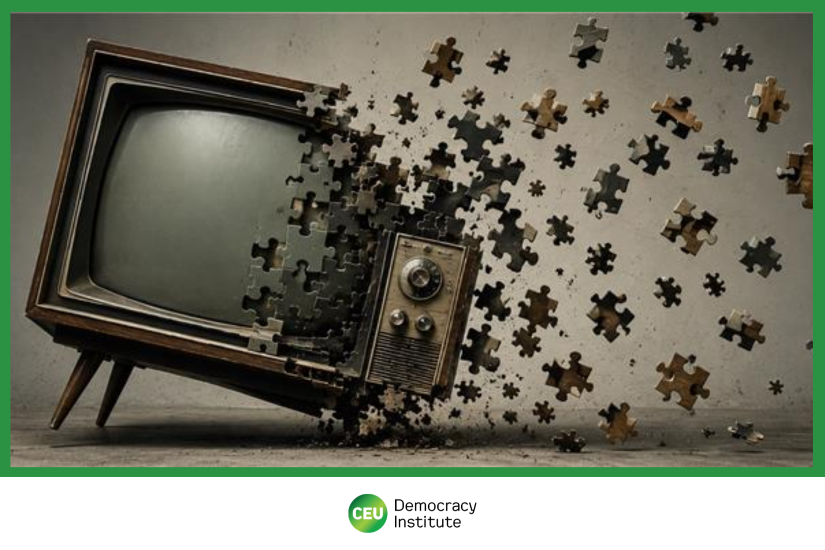
We have extensive experience and literature on the process and nature of capture in the field of media. Following the historic win of the Hungarian opposition, we may have to learn how to un-capture the media in the age of platformization and AI. The 2026 Hungarian general election offers a critical empirical case study: the systemic „un-capturing” of a media environment. Over the past sixteen years, Hungary transitioned from a pluralistic market and a free media system to a sophisticated model of media capture characterized by the instrumentalization of legal-regulatory frameworks, the centralization of ownership via the KESMA conglomerate, the weaponization of state advertising, and the use of a wide range of public resources for political control over the independent media.
This conference interrogates the normative and practical challenges of the „great reconstruction” of our public sphere. Unlike the post-authoritarian transitions of the late 20th century, the current process is complicated by platformization and the proliferation of AI-fuelled disinformation which collectively contribute to a profound deficit of public trust in the media. Our objective is to bridge theoretical insights from comparative academic studies with practical policy design. We seek to explore whether the restoration of democratic media systems requires a mere return to pre-2010 norms or an entirely new paradigm of media governance suited for the public sphere of the late 2020s.
To attend the event, please register using this form by 5 June, 2026.
Schedule
13.00-13.15 – Introductory remarks by Andreas Schedler (Acting Academic Director of the CEU Democracy Institute)
13.15-14.00 – Keynote speech: Vaclav Stetka (Professor, European University Viadrina) (followed by Q&A)
14.00-14.20 – Coffee break
14.20 – 15.30 – Public service media (panel discussion)
In Hungary and across Central and Eastern Europe (CEE), the reconstruction of public service media (PSM) after prolonged political capture raises both institutional and normative dilemmas. Hungarian public broadcasting under the centralized control of entities such as MTVA has been widely criticized for functioning as a government communication apparatus rather than an autonomous public service provider. The challenge is not simply legal independence, but rebuilding editorial cultures, professional norms, and public legitimacy in an environment of deep polarization and distrust. Comparative experiences from countries such as Poland (post-2023 reforms) and Czech Republic suggest that governance reforms—such as depoliticized appointment procedures, multi-stakeholder oversight bodies, and secure multi-year funding—are necessary but insufficient without parallel efforts to re-anchor PSM in society. The Hungarian case thus offers an opportunity to rethink PSM beyond the legacy broadcast model, integrating digital-first strategies and participatory mechanisms that can restore its role as a trusted public institution, and also opens the possibility to reflect on its necessity.
Speakers:
-
Anna Wojcik (Assistant Professor, Kozminski University)
-
Judit Bayer (Associate Professor, Budapest University of Economics and Business)
-
Péter Nádori (Médiafórum Association, Direkt36)
-
Péter Bajomi-Lázár (Professor, Budapest University of Economics and Business)
Moderator:
-
Éva Bognár (Senior Program Officer, CEU Democracy Institute)
15.30 – 15.50 – Coffee break
15.50 – 17.00 – Disinformation, trust, AI
The “un-capturing” of the Hungarian media system unfolds in an information environment increasingly shaped by disinformation, declining trust, and the rapid diffusion of artificial intelligence. Years of state-sponsored narratives and partisan media ecosystems have eroded baseline trust in journalism, a trend mirrored across CEE but particularly acute in Hungary. At the same time, AI-driven content generation and amplification tools—deployed via platforms like Facebook and TikTok—intensify the scale and sophistication of disinformation, complicating regulatory and editorial responses. Internationally, emerging frameworks such as the Digital Services Act point toward stronger platform accountability and risk mitigation obligations, yet their implementation in CEE contexts remains uneven. Rebuilding trust will require a multi-layered approach: strengthening independent journalism, investing in media literacy, and developing transparent AI governance standards. The Hungarian case may thus become a critical testing ground for how democratic societies can recalibrate epistemic authority and public trust under conditions of technological disruption.
Speakers:
-
Alexander Bor (Research Fellow, CEU Democracy Institute)
-
Gabriella Szabó (ELTE-Center for Social Sciences)
-
Karolina Zbytniewska (Editor-in-chief, FocusEurope.pl)
-
Further speakers to be confirmed
Moderator:
-
Bálint Mikola (Post-doctoral researcher, CEU Democracy Institute)
Any queries related to the event should be addressed to Bálint Mikola (mikolab@ceu.edu) or Éva Bognár (bognare@ceu.edu).