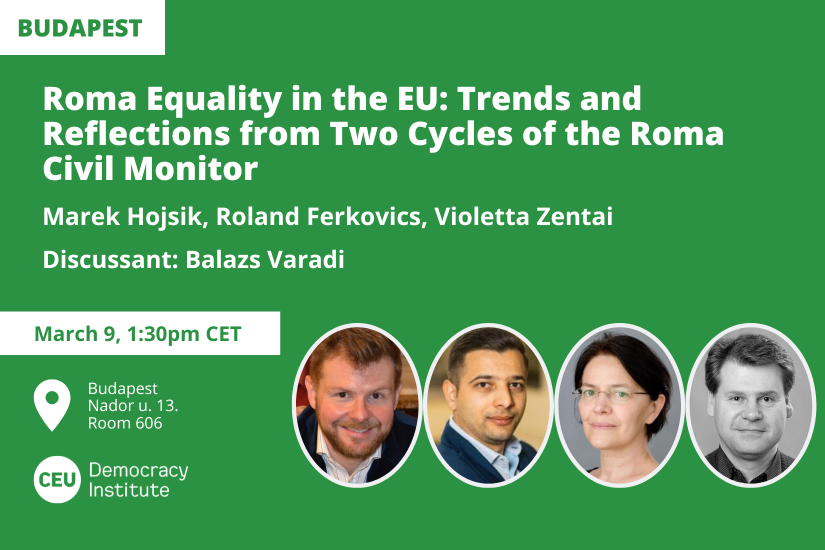
Roma Equality in the EU: Trends and Reflections from Two Cycles of the Roma Civil Monitor
The Inequalities and Democracy Workgroup of the CEU Democracy Institute is delighted to invite you to its public seminar.
You can check our past events here.
If you would like to attend, please register here.
Please keep in mind that external guests will not be able to enter the building without prior registration.
The seminar starts with a 25-minute paper presentation followed by comments from the discussant. Discussion open to the audience follows. To actively take part in the discussion, please read the draft paper beforehand. The paper is available upon request.
This seminar concludes the second edition (2021-2025) of the Roma Civil Monitor (RCM), the EU’s largest civil society monitoring initiative on Roma equality, coordinated by CEU since 2017. Rather than summarising the recently published RCM Synthesis Report, which drew on findings from more than 120 CSOs across Europe, the seminar aims at reflecting on the state of Roma inclusion and on the major patterns and trends that had shaped and constrained progress since the adoption of the first EU Roma Framework in 2011 and its successor in 2020. Eight years of RCM monitoring revealed a persistent gap between political commitment and lived reality, with antigypsyism operating as an underlying grammar within policymaking itself. The presentation argues that the central challenge no longer lay in the absence of strategies or resources, but in the governance architecture through which these are being designed and implemented.
Speakers:
Marek Hojsik has managed the EC-funded initiatives “Roma Civil Monitor” (pilot project 2017-2020 and the current follow-up 2021-2025), implemented by CEU in 27 member states and involving more than 100 civil society organisations and activists. Marek has more than 15 years of professional experience in Roma inclusion and social integration policies in non-governmental organisations and public administration institutions in Slovakia and Czechia. He worked for EC as expert on social inclusion, desegregation and EU Funds; between 2010 to 2012 he was Director General of the Social Development Fund, Slovakia. Between 2008 and 2016 he participated in the Open Society Institute’s programme “Making the Most EU Funds for Roma” in Slovakia and Czechia. Marek is engaged in applied public policy research focused on social inclusion, social housing, de/segregation and EU funds. He is PhD candidate at the Department of Social Geography and Regional Development, Charles University, Prague.
Roland Ferkovics joined the Democracy Institute (DI) as the Co-Manager and Project Officer of Roma Civil Monitor 2021-2025. His responsibilities comprise various aspects such as project management, coordination, communication and provision of strategical inputs. Previously, Roland worked at the Roma Education Fund as the Policy and Advocacy Officer also worked for OSCE, ERRC and OSJI as consultant regarding Roma inclusion issues. He was a researcher in the work of Columbia University and Penn State University on the topic of Roma electoral behavior and representation. In 2016 he has been appointed by the US Embassy to Budapest to the German Marshall Fund (GMF) of the United States Transatlantic Inclusion Leaders Network as a representative as well as awarded with a GMF alumni action project. Roland holds an MA degree from the Central European University Department of Political Science and a BA degree in Political Science from the University of Szeged.
Violetta Zentai is a cultural anthropologist with a PhD from Rutgers University (USA). She was co-director of the Center for Policy Studies at the CEU (2003-2020) before joining the Democracy Institute. She is also a faculty member of the Department of Public Policy and the Department of Sociology and Social Anthropology of the CEU. Her research focuses on intersecting inequalities, social exclusion/inclusion, social movements, and civic solidarity. In the last two decades, she served as a team leader and coordinator of a number of larger comparative European research projects and doctoral training networks. She was a member of the core team of CEU’s Open Learning Initiative (OLIve) in 2017-2022 and has remained active in its new autonomous civic entity.
Discussant:
Balazs Varadi has a PhD in Economics from Yale. He teaches Economics and Political Economy at the Law Faculty of ELTE University and is a founding partner and senior researcher of the Budapest Institute for Policy Analysis, a think tank specializing in evaluation and policy design in several fields. As a policy analyst Balazs has worked on issues of health and education policies as well as issues of Roma inclusion; he has been involved as an expert in the RCM process from the beginning. His academic work is mostly on health economics.