Visegrad Lecture Series – Blinken OSA Archivum
Visegrad Lecture Series
Debating Dis/Unity, Autonomy and Dogmatism at World Congresses: The Communist-Dominated World Federation of Trade Unions (1953–1978)
by Immanuel R. Harisch (University of Vienna).
When: Wednesday, November 6, 2025 | 11:00 a.m.
Where: Archivum, Meeting Room (2nd Floor)
Zoom: https://ceu-edu.zoom.us/j/91299097034?pwd=GuYK1oqUT8ZZRLA3amgQNQQ1KLmeE9.1
Unprecedented labor unity was paved by Allied wartime cooperation. In October 1945, trade unions from Communist, non-Communist and colonial countries established the World Federation of Trade Unions (WFTU) in Paris. However, ideological rifts soon deepened in the intensifying Cold War climate: in 1949, Western Liberal federations quit to form the International Confederation of Free Trade Unions. The WFTU subsequently became dominated by Communist-oriented unions, with affiliates across Africa, Asia, Latin America, and Europe, many of which were linked to national Communist Parties. The Soviet trade union federation took a dominant role. The WFTU’s headquarters moved from Paris (1945–1951) to Vienna (1951–1955), and then to Prague (1956–2004). Since then, they have been in Athens.
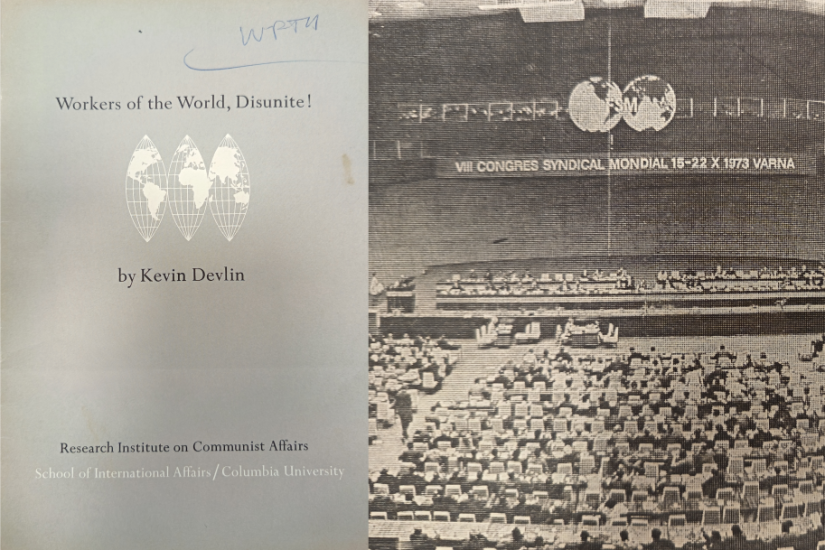
This research, which is part of a special issue on the WFTU that Harisch is co-editing for the International Review of Social History, aims to examine the WFTU’s debates, approach to unionism, and reaction to key historical events during the Cold War era. This presentation will examine the period from the Third World Congress of the WFTU in the Soviet-occupied zone of Vienna, in 1953, until the Ninth World Congress in Prague, in 1978, which was termed the WFTU’s “Disunity Congress” in a Radio Free Europe report. The presentation will primarily focus on public discourse arising from significant international WFTU gatherings, for which the Blinken OSA Archivum possesses extensive material, as well as research reports by individuals such as Kevin Devlin. The presentation outlines debates surrounding dis/unity, autonomy, and dogmatism, focusing on specific WFTU member unions, such as the Italian Confederazione Generale Italiana del Lavoro and the Romanian trade union federation. Key historical events and processes of the Cold War, such as the Sino-Soviet split and the invasion of Czechoslovakia, are examined alongside the détente in Europe and the increasing emphasis on human rights discourse through the prism of the WFTU. This enables us to develop a more nuanced and complex understanding of the WFTU, which is often characterized as the most significant “Soviet front organization.”