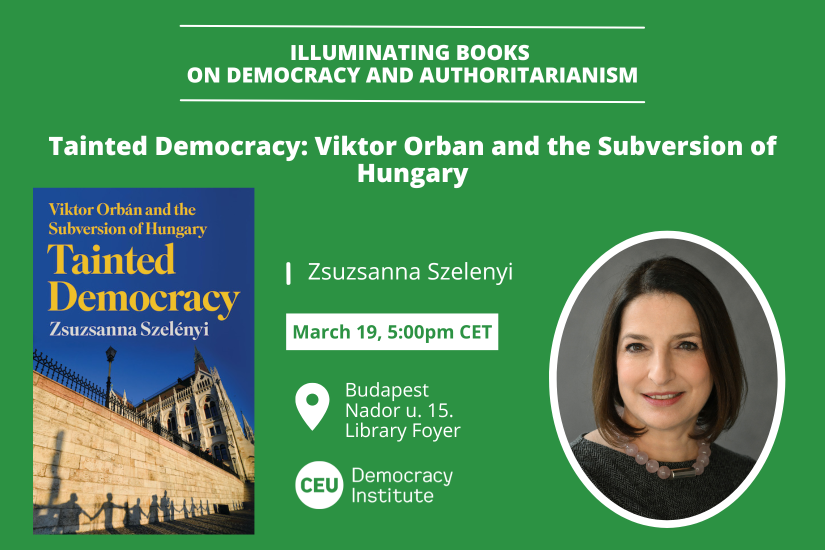
Tainted Democracy: Viktor Orban and the Subversion of Hungary
The De- and Re-Democratization (DRD) Workgroup of the CEU Democracy Institute cordially invites you to a special edition of its series „Illuminating Books on Democracy and Authoritarianism”, co-organized under the „Confronting Goliath: Hungarian Authoritarian Elections in Comparative Perspective” discussion series.
If you would like to attend, please register here.
If you would like to receive information about upcoming llluminating Books or other events organized by the Workgroup, sign up for the DRD mailing list here.
Book:
Zsuzsanna Szelenyi: Tainted Democracy. Viktor Orban and the Subversion of Hungary (Hurst, 2022)
Hungary, once the poster-child of liberal democracy, is fast becoming an autocracy under Viktor Orban. After winning an absolute majority in 2010, Orbán launched a series of ‘reforms’, fundamentally undermining the country’s twenty-year, post-Cold War liberal consensus. For supporters and foes alike, the rise and rise of Hungary’s prime minister is a vivid example of how democracy can be subverted from within.
Zsuzsanna Szelenyi, a leading member of Orban’s Fidesz in its early years, has witnessed first-hand the party’s shift from liberalism to populist nationalism. Offering an insider’s account of Fidesz’s evolution since its creation, she explains how the party rose to leadership of the country under Orban and made sweeping legal, political and economic changes to solidify its grip on power—from reining in the public media to slashing the number of parliamentary seats. She answers a key question: why has Orban been so successful, winning widespread support within Hungary and wielding considerable influence in European politics? And how can Hungary’s opposition party Together, which she co-founded in 2014, work to turn the country around?
Underpinned by Szelenyi’s own experiences at the heart of Hungarian politics, Tainted Democracy offers accessible, nuanced insights into the global rise of populist autocracy—and how it can be challenged.
Speaker:
Zsuzsanna Szelenyi is Visiting Researcher and Program Director of the Democracy Institute Leadership Academy. Before joining the CEU Democracy Institute, she was Richard von Weizsäcker fellow at the Robert Bosch Academy and Fellow of the IWM’s Europe’s Futures program conducting research on autocratization within the European Union. In 2014-2018 Ms Szelenyi was a liberal Member of Parliament in Hungary, covering foreign policy, migration and constitutional affairs.Between 1996-2012 she served at the Council of Europe for fifteen year and worked with international organizations in North Africa. Ms. Szelenyi started her career as member of Fidesz at the régime change in 1988, served as Member of Parliament but left politics in 1994 for a professional career. Ms Szelenyi completed GMAP of International Politics and Economics at the Fletcher School of Law and Diplomacy, holds an MA of Psychology of the University of Eotvos Lorand, and an MA of International Relations of the Corvinus University.
Discussants:
Veronika Kovesdi is a media researcher, a PhD Candidate at Eötvös Loránd University (ELTE), an Assistant Professor at the Communication and Media Department (ELTE) and a Junior Research Fellow at the Institute for Political Science (ELTE). Her research focuses on the mechanisms of strategic communication, persuasion, and manipulation through an interdisciplinary approach, primarily in the context of contemporary belief systems and charisma.
Peter Techet is a Research Associate (Institute for the Danube Region and Central Europe) and a Postdoctoral Researcher (University of Zurich). He holds PhDs in European history and law and is a researcher at the Institute for East and Southeast European Studies, the Institute of European History, and the University of Freiburg. He is a Visiting Fellow at the Austrian Historical Institute (Rome), NYU, and the Universities of Genoa and Lucerne. His research focuses on the history, law, and politics of Austria and Central and Southeast Europe, and he is a regular commentator for Die Presse and Neue Zürcher Zeitung.
Chair:
Zsofia Bocskay is a post-doctoral researcher at the CEU Democracy Institute and a member of the Research Group on De- and Re-Democratization. She holds a PhD in Political Science from Koç University, Istanbul, where she remains affiliated. Her research focuses on political communication in autocratizing states, particularly how government and opposition parties use agenda-setting, populist appeals, and campaign negativity to shape public discourse. While her core work centers on elite-level communication, she also studies media systems and voter behavior more broadly, including the role of misinformation, issue positioning, and political news consumption in competitive authoritarian regimes. She pays special attention to local elections, examining how political actors use these arenas to consolidate or challenge power. Her research has been published in The International Journal of Press/Politics. Zsofia also organizes the DRD Workgroup’s Illuminating Books series on recent academic work in democracy and politics.