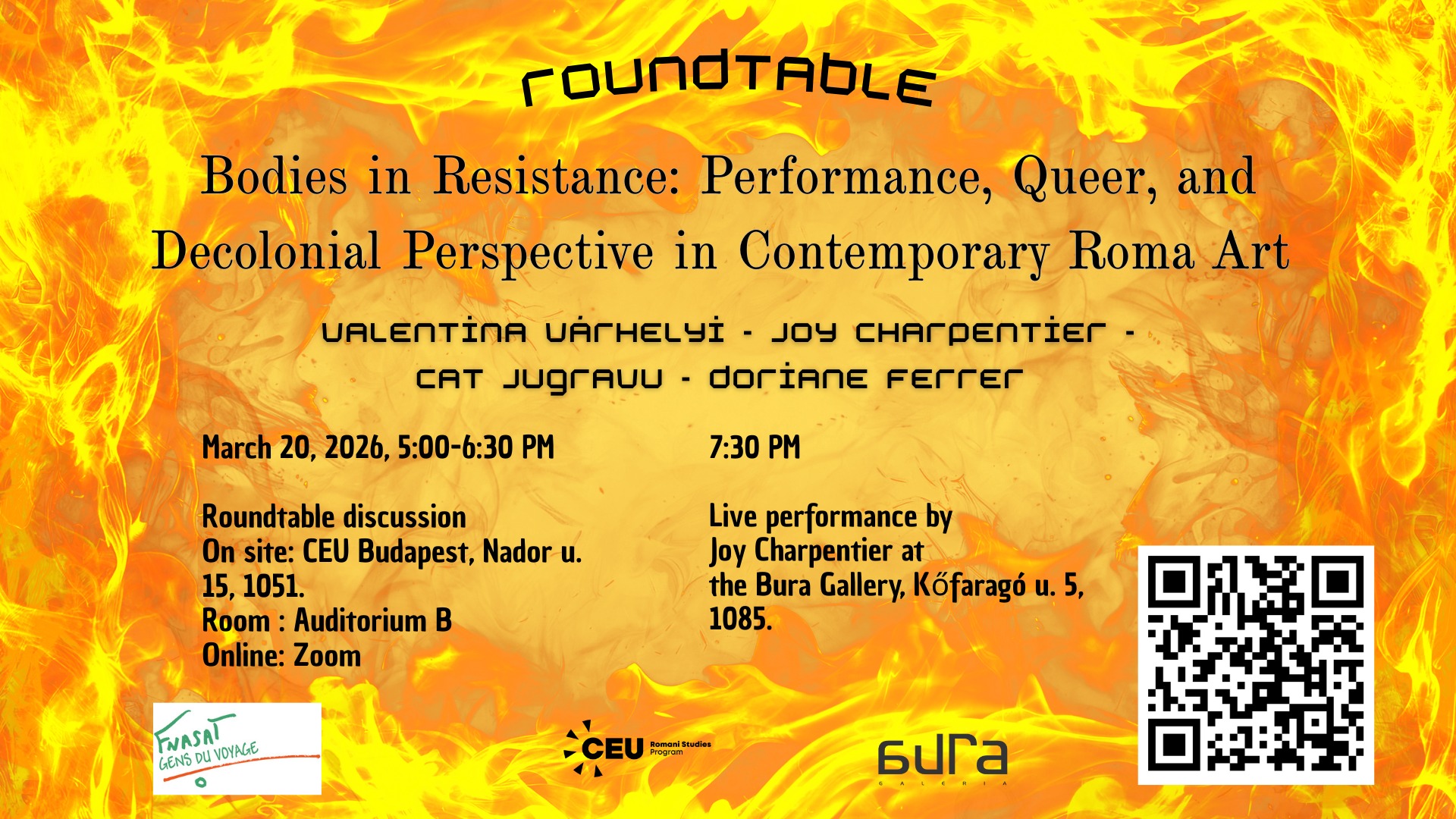
Bodies in Resistance: Performance, Queer, and Decolonial Perspective in Contemporary Roma Art
Description:
The roundtable aligns with the line of Roma, queer, feminist, and decolonial current of thought. By inviting three performing artists the discussion will focus on their art practices and the body as a framework for analysis. The Roma body, racialised and gendered, conceived as a territory where the struggle against colonial power unfolds, constitutes the primary site of resistance. Drawing on a decolonial queer framework and influenced by performance studies, the performance emerges as a privileged medium for expressing one’s agency and as a radical act of creating revolutionary experimental spaces, imagining alternative models at the forefront of post-normative thought. These practices embody fluidity, ambiguity, ephemerality and transformation, producing liminal spaces for renegotiation, contestation, and the dismantling of normative frameworks, their limits, and their mechanisms of control.
Speakers:
– Várhelyi Valentina (artist)
She was born in 1998 on the outskirts of Budapest. She grew up in a family that, often unconsciously, preserved elements of Roma tradition. This background nurtured a sense of curiosity and humility that continues to shape her practice, with particular attention to the relationship between humans and objects. In her formative years as an artist, she experimented with literature and theatre, which naturally led her to the world of music and performance. Following her studies in art history and curatorial practice in the Hungarian University of Fine Arts, her focus shifted toward rethinking the boundaries between science and art.
Her thinking was shaped by the research of posthuman and anthropocene critical theories. The study of rhizome theories formed the basis of her current creative practice, expressed through immersive multimedia installations, performances, and action art. In recent years, she incorporated graphic design and video art into her work. Her artistic approach relies on the organic and authentic relationship between the material and the method it is touched with. This connection allows her a playful freedom that supports abstraction and experimental approaches across different subjects.
Her works focus on exploring Roma heritage and researching the history of magic and alchemy, through which he seeks to transcend the identity politics dogmas of contemporary art. Her intention is to question power structures rooted in claims of scientific superiority. She is convinced that alternative culture can serve as a powerful tool against systematic oppression and social division.
– Joy Charpentier (artist)
Born in 1991 in Thiais, France, Joy Charpentier lives and works in Montpellier. A member of the travelling community, he was raised a gypsy community and used to travel with his family to fairs in evangelical convoys. A multidisciplinary artist, his research reflects the confrontation of this background and queer identity with normative standards.
His practice is a tool for deconstructing phenomena of violence: by means of the reappropriation of stereotypes or diversion, his work aims to overturn, reevaluate or reinvest fields of representation. He experiments with different mediums, from drawing to performance or installation, with forms that are often absurd, trashy, kitsch, or in bad taste. Taking up the figure of the jester or the phenomenon of carnival, humor is used in its political and social dimension, and becomes a material of struggle, revealing the reality that re-examines the rules of the game.
Joy Charpentier has taken part in several exhibitions across France and Europe. In 2024, he presented his first solo exhibition, ‘Narvaland”, at Reflet Machine in Paris.
In 2017, he founded the artist collective “Groupe Vengeance”.
Since 2021, he has been a resident performer of the burlesque cabaret CrazyMorse in Montpellier.
– Cat Jugravu (artist)
Cat Jugravu (Romanian Romani) is a Berlin-based theatre director, performer, poet, and social worker. Her interdisciplinary practice operates at the intersection of performance, critical pedagogy, and curation, developing collective methodologies that interrogate memory, representation, and cultural authority. She is the founder and artistic director of the QUEERDOS Kollektiv and a core member of the DePART Collective. Through these structures, she facilitates spaces where authorship and visibility are examined as functions of power. Her projects—encompassing performance, installation, and long-term workshops—often function as performative archives, creating shared platforms for knowledge production that challenge extractive cultural norms. Jugravu’s work has been presented in institutional and grassroots contexts across Europe. She approaches performance as a mode of critical inquiry and collective negotiation, centering refusal as a methodology, and care as an infrastructural principle.
– Doriane Ferrer (moderator)
She holds a MA in Social Sciences with a focus on art from Ecole des Hautes Etudes en Sciences Sociales, Paris. Her master’s thesis, titled „Weaving Romani, Feminist, and Decolonial Resistance: A Study of Delaine Le Bas’s Work, 1998-2025” has deepened her knowledge in contemporary Roma art. This year, she joined the Roma Graduate Preparation Program at Central European University, Budapest. She aspires to pursue a PhD with research centered on queer Roma performance practices, and is eager to engage further collective artistic, cultural and activist projects.